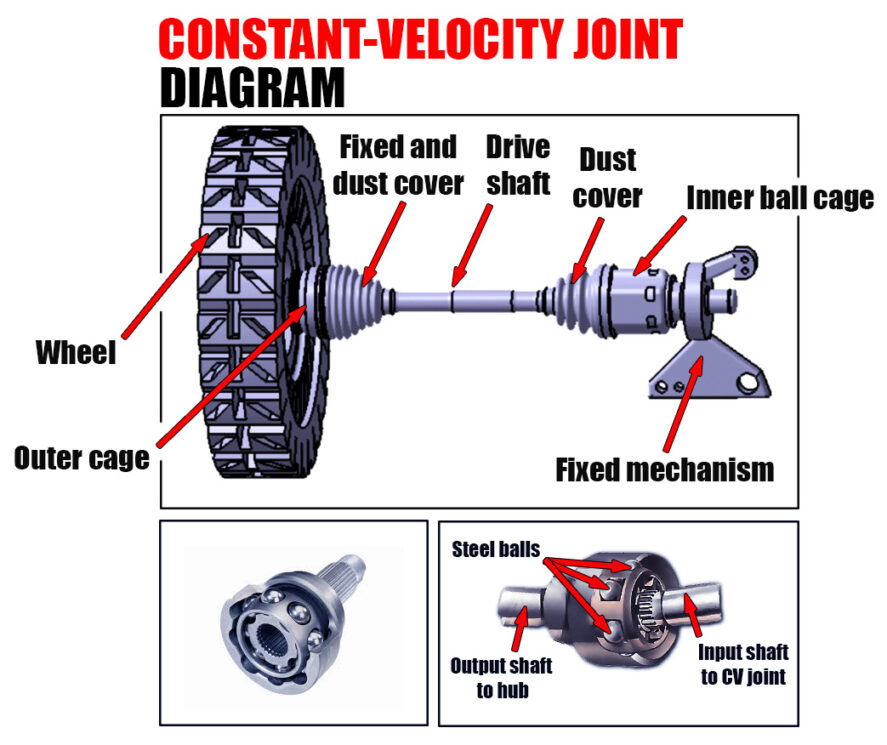
Constant-Velocity Joints
In modern automotive engineering, the constant-velocity (CV) joint is a crucial component that ensures the smooth and efficient transfer of power from the engine to the wheels, particularly in front-wheel-drive vehicles. Unlike traditional universal joints, CV joints are specifically designed to accommodate both drive and steering actions simultaneously. This unique capability makes them indispensable in the complex mechanics of front-wheel-drive systems, where the wheels must be able to steer and move up and down with the suspension while still receiving consistent power.
Structure and Function of the CV Joint
The CV joint is engineered to maintain a constant rotational speed of the driven shaft, regardless of the angle or distance between the final-drive unit and the wheels. This is achieved through a sophisticated design that utilizes grooves and steel ball bearings instead of the cross-shaped ‘spider’ found in traditional universal joints. The grooves are precisely machined to allow the steel balls to move within them smoothly, ensuring that power is transmitted without fluctuations in speed or efficiency, even when the angle between the shafts changes.
This design is particularly advantageous in front-wheel-drive vehicles, where the drive shafts must cope with both the vertical movement of the suspension and the horizontal movement of steering. The ability of the CV joint to handle these simultaneous movements without compromising the consistency of power transmission is what sets it apart from other types of joints.
Application in Front-Wheel-Drive Systems
In front-wheel-drive cars, the drive shafts that connect the final-drive unit to the wheels must be capable of handling a range of movements and angles due to the vehicle’s steering and suspension dynamics. The CV joint excels in this environment, providing a seamless transfer of power even as the wheels steer and the suspension moves up and down. This capability is critical for maintaining vehicle stability and control, especially when navigating turns or uneven road surfaces.
The constant speed of power transmission provided by the CV joint also contributes to a smoother driving experience, as it eliminates the vibrations and fluctuations that can occur with other types of joints. This not only enhances comfort but also reduces wear and tear on the drivetrain components, contributing to the longevity of the vehicle.
Comparison with Traditional Universal Joints
While traditional universal joints, such as the ‘spider’ joints found in rear-wheel-drive vehicles, perform a similar function in allowing the drive shaft to accommodate suspension movement, they do so with a different mechanism. In some vehicles, particularly earlier models like the Mini, drive-shaft couplings that use ‘spider’ joints are employed. These joints are typically made of rubber bonded to metal and allow for up-and-down movement of the suspension. However, unlike CV joints, they do not maintain a constant velocity, which can lead to fluctuations in power transmission at varying angles.
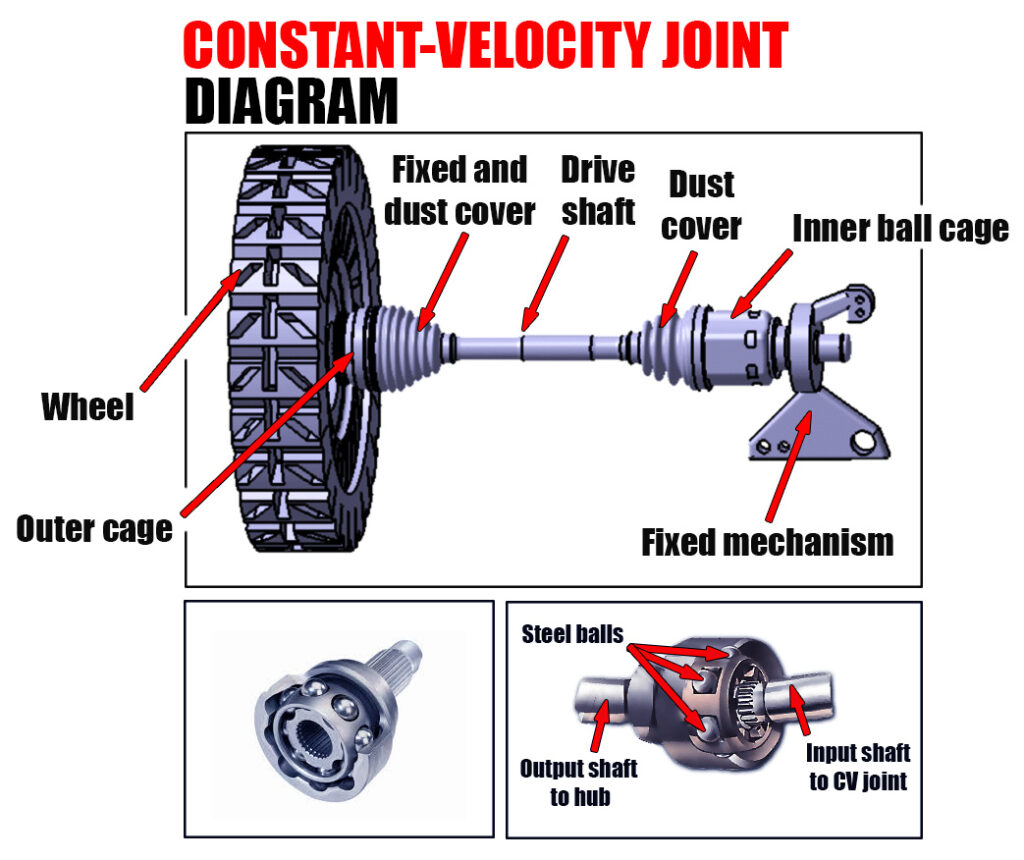
This difference is particularly noticeable in front-wheel-drive vehicles, where the ability to maintain a constant velocity is critical for the smooth operation of both the drivetrain and the steering system. The CV joint’s superior design makes it the preferred choice in these applications, providing both reliability and performance.
The constant-velocity (CV) joint represents a significant advancement in automotive engineering, particularly for front-wheel-drive vehicles. Its ability to transmit power consistently, regardless of the angle or movement of the suspension and steering, makes it an essential component in modern drivetrains. By understanding the structure and function of the CV joint, along with its advantages over traditional universal joints, we gain a deeper appreciation for the complexities of vehicle mechanics and the innovations that drive the automotive industry forward.
