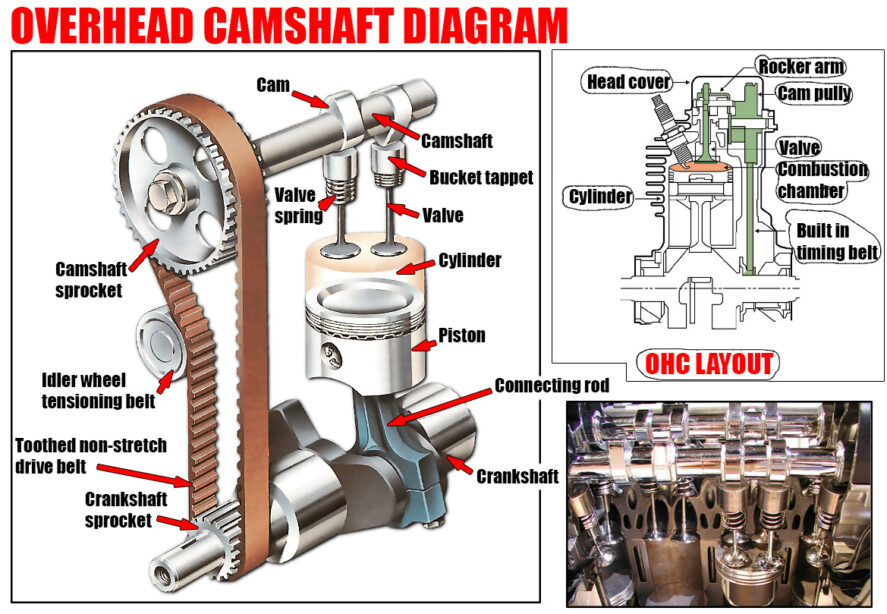
The overhead camshaft (OHC) engine is a widely used configuration in modern internal combustion engines, known for its efficiency and simplicity in valve operation. This article explores the design, function, and advantages of OHC engines, highlighting how they differ from other valve train configurations and the benefits they offer in terms of performance and mechanical efficiency.
The Basics of Overhead Camshaft (OHC) Design
In an overhead camshaft engine, the camshaft is located above the cylinder head, directly above the valves. This positioning eliminates the need for pushrods, which are typically used in overhead valve (OHV) engines to transfer motion from the camshaft located in the engine block to the valves. By placing the camshaft directly above the valves, OHC engines can reduce the number of moving parts, resulting in less mechanical complexity and lower weight.
The camshaft in an OHC engine controls the opening and closing of the engine’s valves by acting directly on bucket tappets or short levers, commonly known as fingers. These components, in turn, act directly on the valve stems, ensuring precise and efficient valve operation. This direct action is one of the key advantages of OHC engines, as it improves the timing and responsiveness of the valve train.
Advantages of the Overhead Camshaft Configuration
The overhead camshaft configuration offers several significant advantages over traditional pushrod engines:
- Reduced Mechanical Complexity: OHC engines do away with the need for pushrods and rocker arms, reducing the number of components involved in the valve train. This simplification leads to increased reliability and lower maintenance requirements.
- Improved Valve Timing Accuracy: With the camshaft located directly above the valves, the timing of valve operation can be more precise, leading to better engine performance, especially at higher RPMs. This precision is crucial for optimizing the engine’s power output and fuel efficiency.
- Lower Weight: By eliminating pushrods and rocker arms, OHC engines reduce the overall weight of the valve train. This weight reduction contributes to better engine efficiency and performance, as there is less inertia to overcome when operating the valves.
- Higher RPM Capability: The reduced mass and direct action of the OHC configuration allow for higher engine speeds (RPMs) without the risk of valve float, where the valves fail to close properly at high speeds. This makes OHC engines particularly well-suited for high-performance applications.
Camshaft Drive Mechanism
One of the challenges in OHC engine design is how to drive the camshaft, which is positioned high in the engine. Typically, a timing chain or timing belt is used to connect the camshaft to the crankshaft, ensuring that the camshaft rotates in synchrony with the engine’s pistons.
In many OHC designs, a long chain is employed to drive the camshaft directly from a sprocket on the crankshaft. However, long chains can be prone to whipping, which can cause noise, wear, and even failure if not properly managed. To address this issue, some engine designs use intermediate sprockets and two shorter drive chains instead of a single long chain. These shorter chains are kept under tension, reducing the risk of whipping and ensuring reliable operation over the engine’s lifespan.
Variants of Overhead Camshaft Engines
There are two main types of OHC engines, each offering unique advantages depending on the specific design and application:
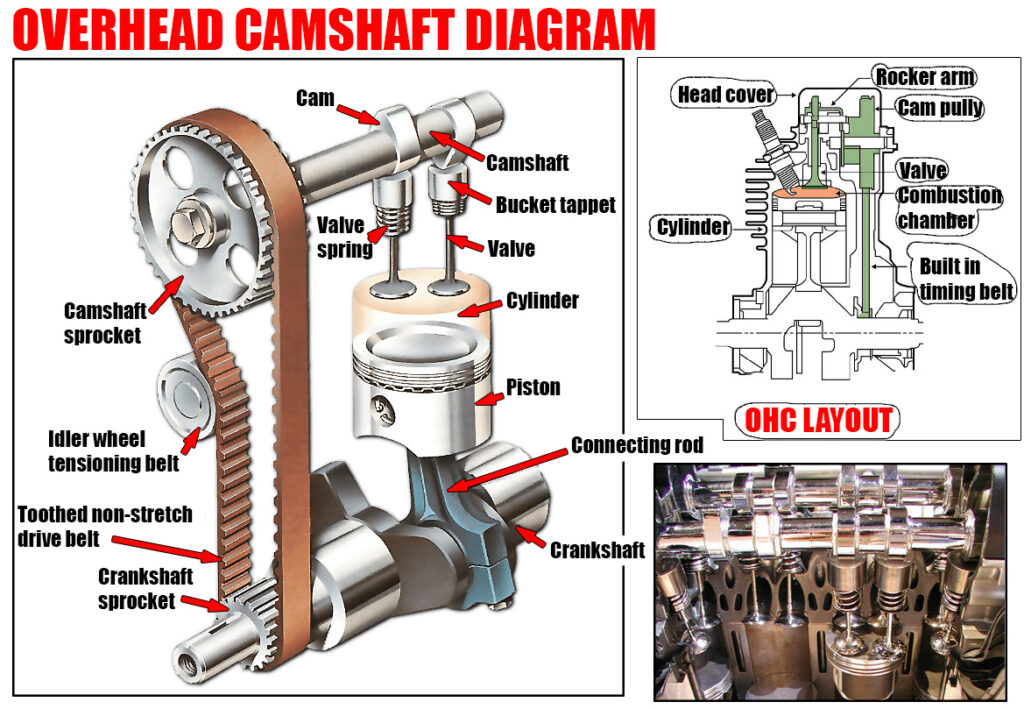
- Single Overhead Camshaft (SOHC): In SOHC engines, a single camshaft operates both the intake and exhaust valves. This configuration is simpler and lighter than a dual camshaft setup and is often found in engines where compactness and simplicity are priorities.
- Double Overhead Camshaft (DOHC): DOHC engines use two camshafts, one for the intake valves and one for the exhaust valves. This allows for greater flexibility in valve timing and lift, which can improve engine performance, particularly at high speeds. DOHC engines are commonly used in high-performance and sports cars, where maximizing power output is essential.
Overhead camshaft engines represent a significant advancement in internal combustion engine design, offering a more efficient and mechanically simpler solution for valve operation. By placing the camshaft directly above the valves and reducing the number of moving parts, OHC engines deliver improved performance, higher RPM capabilities, and enhanced reliability. Whether in single or double camshaft configurations, the OHC engine remains a cornerstone of modern automotive engineering, providing the power and efficiency needed to meet the demands of today’s vehicles.
